Standard pedigree notation (ISCN/HGNC)
Per-individual consent-to-share flags
No installation required
BayesMendel R engine (peer-reviewed)•ICD-10 & OMIM coded•For teaching, research, and documentation — not a medical device
evagene.net/pedigree/brca-family
230+ Diseases
6 Risk Models
The Problem
Existing pedigree tools cost clinicians time, not save it
Paper charts get lost in handover. General-purpose diagramming tools don't understand affection fill or proband arrows. Legacy genetics software forces you to re-key family data into a separate BayesMendel calculator — and none of it runs in a browser.
The result: consultation time wasted on tools rather than patients. Incompatible exports between research teams. Families locked out of their own history.
Evagene
Draw. Annotate. Analyse. Export. One tab.
Evagene combines gesture-based pedigree drawing, deep clinical data modelling, Bayesian risk analysis, and universal data exchange — in a single browser application with no installation.
Draw a circle for a female. A square for a male. Connect them. Add diseases with ICD-10 codes. Run BRCAPRO. Export to PDF. That is the entire workflow.
Pick up a stylus — or use your finger, mouse, or trackpad — and draw directly on the canvas. Circles, squares, diamonds, connecting lines. Exactly as you would with pencil and paper.
As you sketch, Evagene recognises each gesture in real time and builds a fully structured genetic model underneath: individuals, relationships, generations, and lineage — ready for annotation, risk analysis, and export.
No menus. No toolbars. No learning curve. If you can draw a pedigree on paper, you can draw one in Evagene.
Drawing a pedigree on iPad with Apple Pencil — gestures become structured data in real time
New · Build a pedigree in under a minute
Describe your family in plain English. Get back a pedigree.
Our ChatGPT Custom GPT — Evagene Pedigree Builder — turns a natural-language family description into a valid Evagene pedigree JSON file. Describe who is in your family, what conditions they have, and any genetic test results you know about. The GPT asks clarifying questions where family structure is ambiguous and returns a downloadable file.
Load the file into Evagene via File → Load pedigree → Load Evagene file and the pedigree renders in standard notation, ready for risk analysis.
Requires a paid ChatGPT subscription (Plus / Team / Enterprise) — OpenAI's policy for all Custom GPTs, not an Evagene paywall. ChatGPT helps you produce a valid Evagene file; the analysis runs in Evagene after import.
chatgpt.com · Evagene Pedigree Builder
My maternal grandmother had breast cancer at 52, my mother at 45, and my aunt has ovarian cancer. Build a pedigree with me as proband.
Quick check — the aunt with ovarian cancer: is she on the maternal side too, and roughly what age at diagnosis?
Yes, maternal. Diagnosed at 60.
Here's your pedigree. Three generations on the maternal side with three affected relatives and you as proband. The pattern is suggestive of hereditary breast / ovarian cancer — run BRCAPRO in Evagene for a quantitative read.
hboc-family.json
Evagene pedigree · 12 individuals
Load in Evagene via File → Load pedigree → Load Evagene file.
Illustrative conversation — the GPT asks clarifying questions, then returns a JSON pedigree file.
A complete pedigree platform, not another drawing tool
From gesture-based canvas drawing to implementations of published Bayesian risk-model algorithms and GEDCOM interoperability — a full research and education surface in an interface anyone can learn in minutes.
Gesture Drawing
Freehand-draw circles, squares, and diamonds on the HTML5 canvas. Draw lines to form relationships. Natural as pen and paper, with keyboard accelerators.
MFUPshortcuts
Family History Questionnaire
A guided, step-by-step intake that records a family and personal health history and turns it into a pedigree — relatives, relationships, and findings wired up for you. Educational data capture, not a medical assessment.
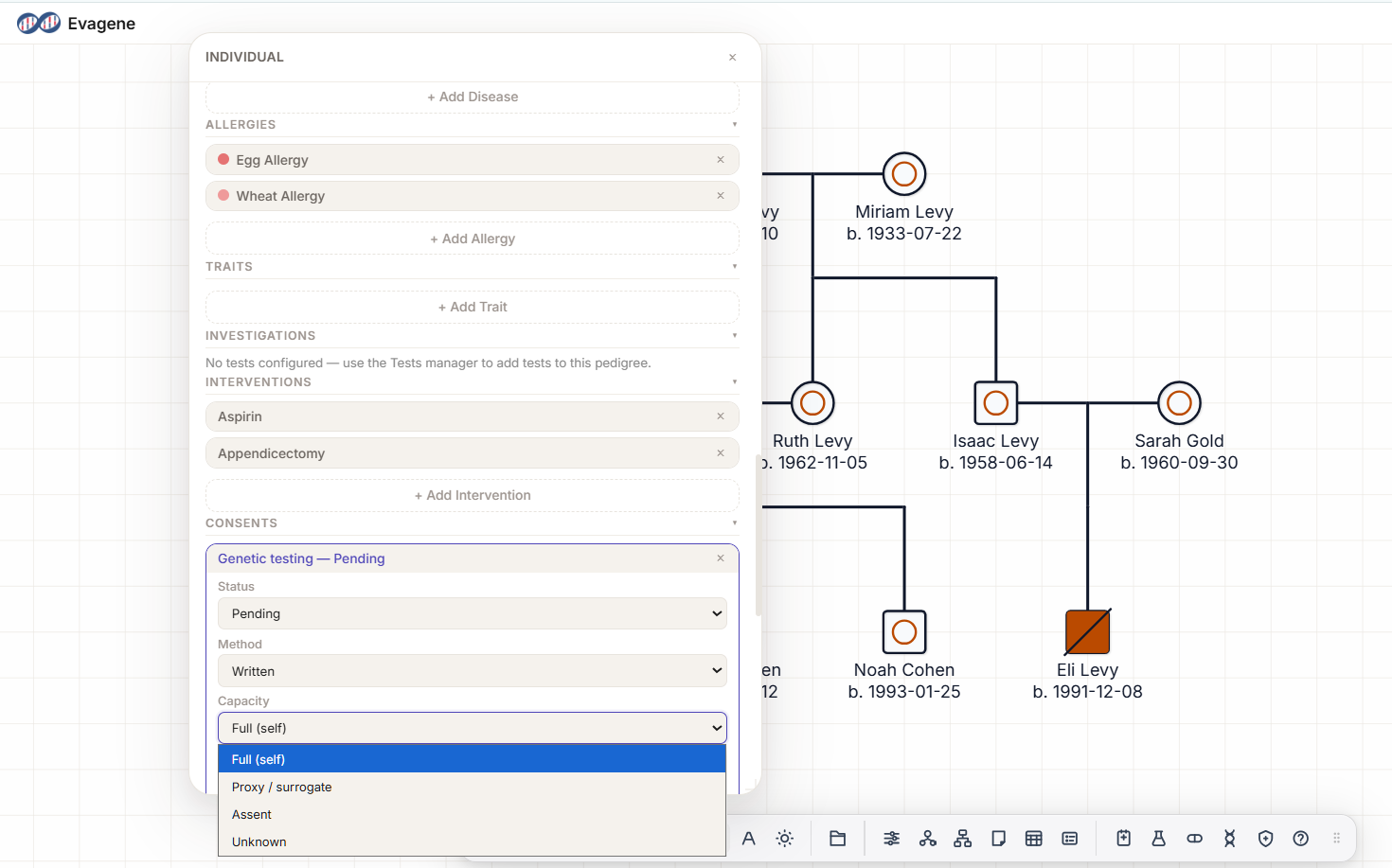
Floating panel — draggable, resizable from any edge or corner, with a dock icon that highlights when open: identity (8 biological sex options), death status (12 options), lifestyle, contact fields, consent-to-share flags, relationship events — all synced in real time.
230+ Disease Catalog
Oncology, cardiology, neurology, metabolic, plus 20+ catalogued complex / multifactorial conditions — each entry carries ICD-10, OMIM, MONDO, Orphanet, and DOID cross-references, inheritance pattern, penetrance tables, heritability, empirical recurrence risks, and carrier frequencies by ancestry. Manage from a dedicated dashboard with presets and custom colours.
Bayesian Risk Models
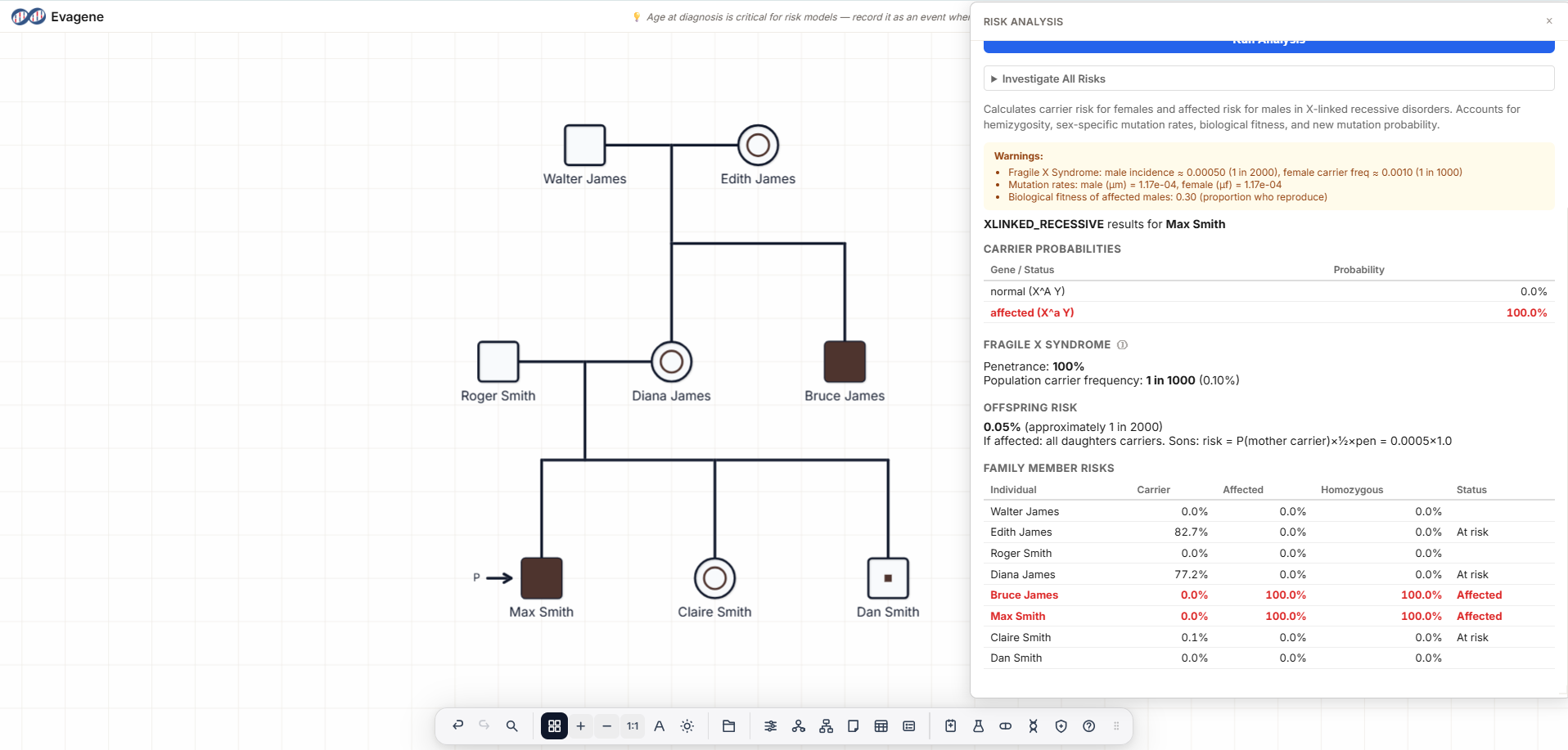
BRCAPRO, MMRpro, PancPRO via BayesMendel. Claus, Couch, Frank, Manchester, NICE, Amsterdam II, Bethesda, Gail, a Tyrer-Cuzick IBIS-style approximation, and an educational prostate-cancer family-history model alongside. AD / AR / XLR Mendelian with age-dependent penetrance; X-linked dominant with sex-differential severity; mitochondrial with heteroplasmy scaling; digenic two-locus; imprinting / UPD with parent-of-origin weighting. Polygenic / multifactorial liability-threshold engine covering 20+ complex conditions. One-click CanRisk export.
Interactive Karyogram
Ideogram of all chromosomes with genetic markers at genomic positions, colour-coded by test result (positive / VUS / negative), with centromere bands.
Broad Data Exchange
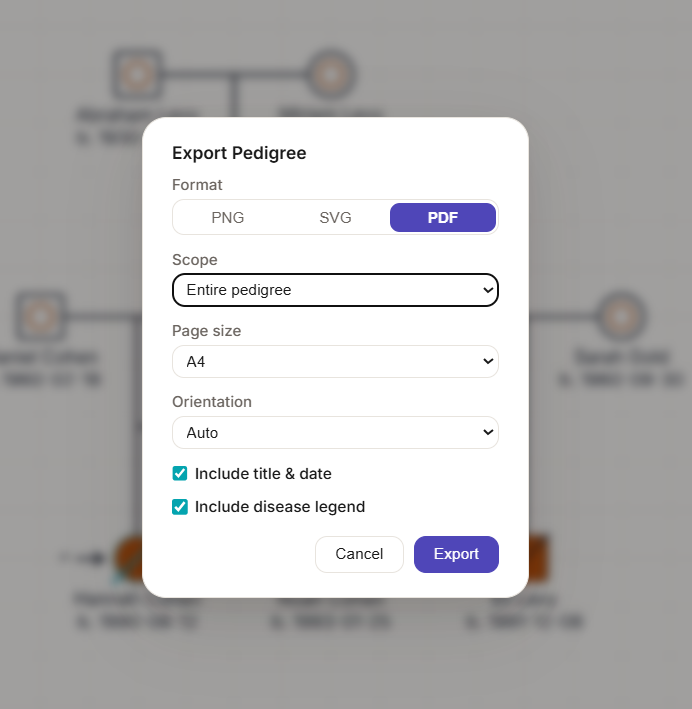
Import JSON, GEDCOM 5.5.1, GA4GH Phenopackets v2, XEG, 23andMe, and images (OCR). Export to JSON, GEDCOM, GA4GH Phenopackets v2, PNG (up to 4x), SVG, PDF (A4/A3/Letter/Legal), and DOCX.
HPO Phenotyping
Browse a curated Human Phenotype Ontology catalogue and attach observed or excluded phenotype features — with onset and severity — to individuals. Recorded features surface candidate phenotype-to-gene educational associations. Reference data for teaching and documentation, not diagnosis.
Consanguinity, Kinship & IBD
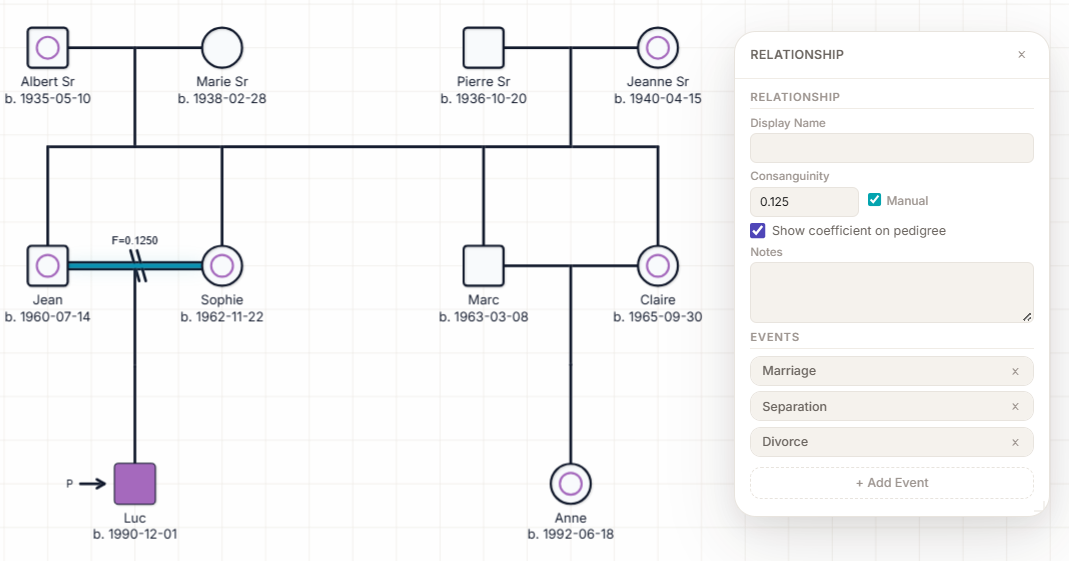
Wright's path coefficient calculates consanguinity automatically on relationship lines and into the risk models. A relatedness module adds full pairwise kinship coefficients, per-individual inbreeding, Jacquard k0/k1/k2 identity coefficients, and gene-dropping simulation — for education and research.
Advanced Search
Query builder: filter by sex, disease status, age, tests, treatments — across parents, siblings, ancestors, descendants. AND/OR modes. Results highlighted on canvas.
Batch Investigation
Explore multiple algorithm families against a proband simultaneously. Generate dual-audience educational summaries: one in plain language, one with structured detail. For review, teaching, and documentation — not clinical recommendation.
Allergies & Traits
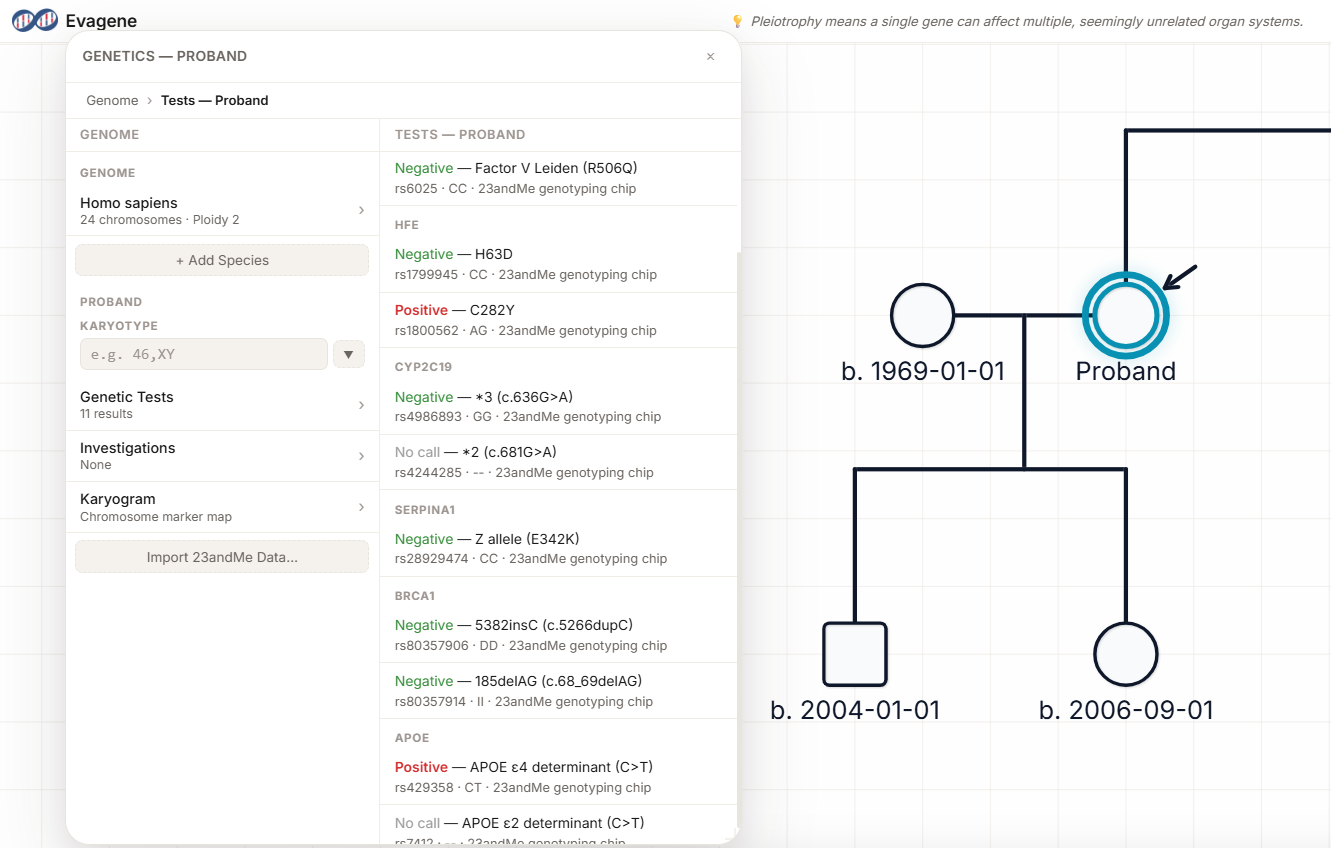
55+ allergies (severity, IgE, cross-reactivity). 50+ traits (heritability, marker associations) with automatic inference of blood type, Rh factor, and secretor status from 23andMe SNP data.
An educational correlation graph links diseases, traits, clinical-test results, allergies, and markers, surfaced as you annotate — with status-aware test edges (low vs high ferritin). Educational reference, not risk analysis or diagnosis.
Generate AI-assisted draft summaries for educational / research review — structural observations, documentation gaps, and discussion prompts, anchored directly to the proband on the canvas. Drafts for human review — not clinical advice, not diagnostic output.
Blood Type & Trait Inference
Import 23andMe SNP data and Evagene automatically infers ABO blood type, Rh factor, and secretor status from genotype markers. Traits display as visual cards alongside the pedigree.
Disease Management Dashboard
Browse, search, and manage your disease collection from a dedicated dashboard. Quick-add presets (heritable cancers, cardiovascular), taxonomy views, custom colours, and ICD-10 filtering.
Pedigree Reports & Rich Text
Auto-generate structured English reports describing the proband and family findings. Rich markdown editor with formatting toolbar, live preview, and anchored canvas notes that follow individuals.
Researchers and research cohorts, educators and students, trainees, genealogists, and families documenting their own history. Pick a role below.
Replace paper charts and workarounds with a purpose-built system
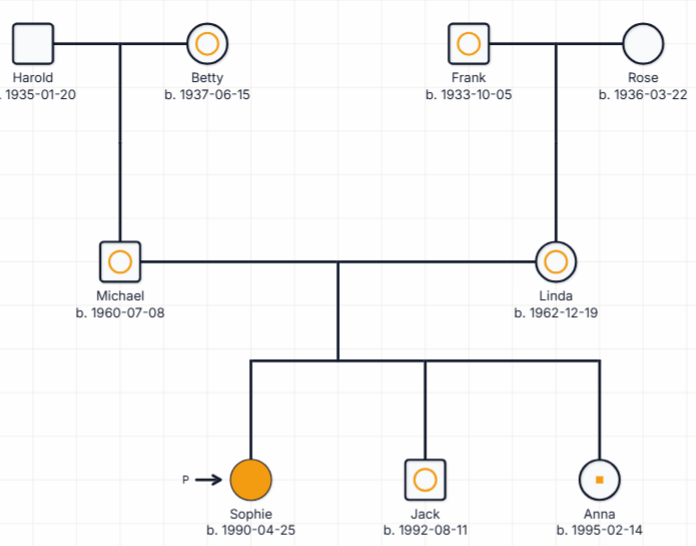
Every symbol, fill pattern, and overlay follows standard clinical pedigree conventions — eliminating the ambiguity of hand-drawn charts and the limitations of diagramming tools.
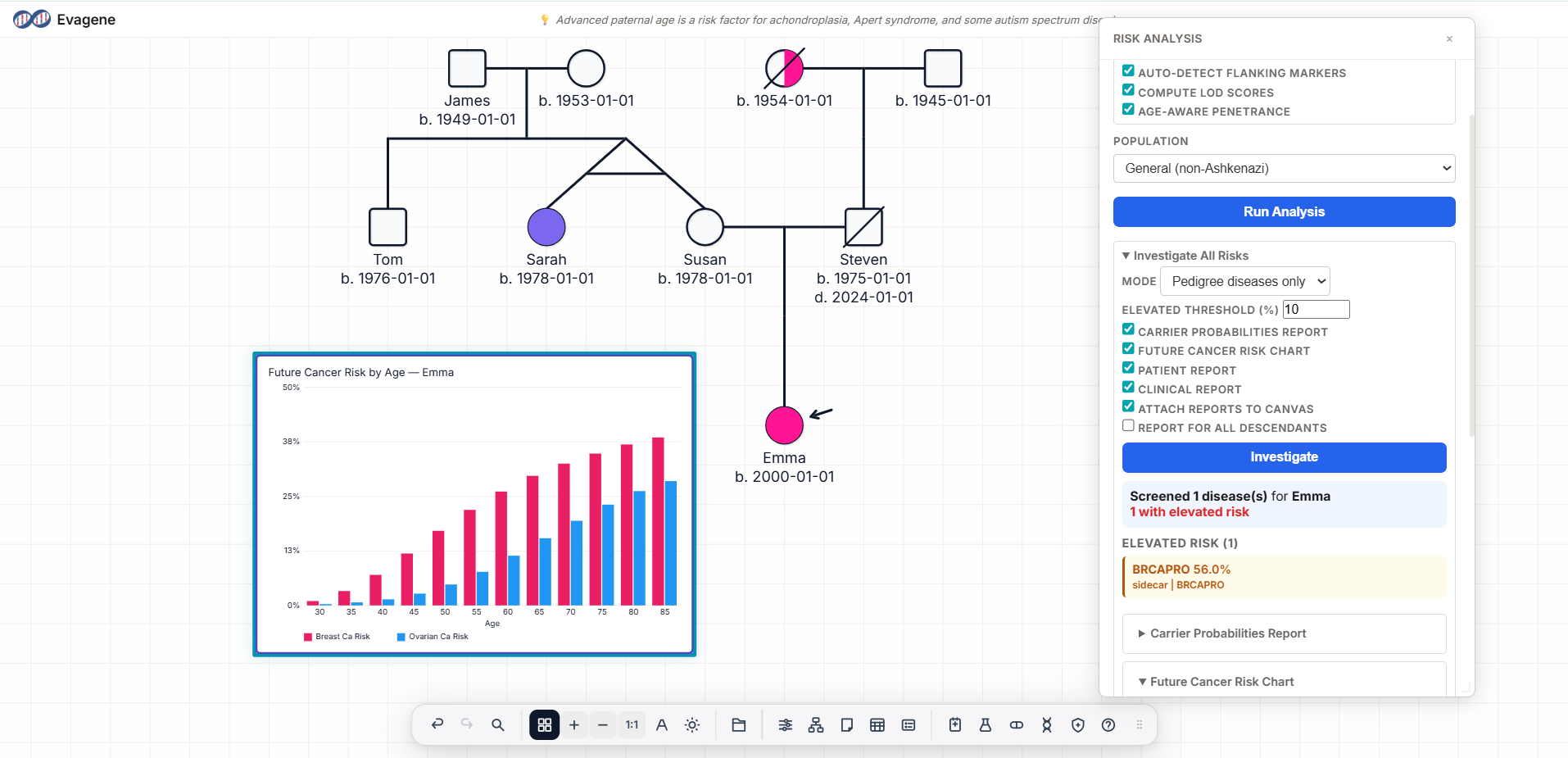
Run BRCAPRO, MMRpro, PancPRO, and Mendelian risk models directly from the pedigree — no re-entering data
230+ diseases pre-configured with ICD-10, OMIM, inheritance patterns, penetrance data, and ancestry-specific carrier frequencies
Batch risk exploration: screen a proband across all diseases with plain-language, structured, carrier, and AI-generated educational summaries
AI-assisted draft summaries for educational review: structural observations, documentation gaps, and discussion prompts
Personalised hereditary cancer risk from the full family history
BRCAPRO (breast/ovarian), MMRpro (colorectal/endometrial), and PancPRO (pancreatic) deliver Bayesian risk estimates that account for both affected and unaffected relatives across multiple generations.
Record tumour laterality, site, ER/PR/HER2 status, grade, and stage per disease per individual
Track chemotherapy, surgery, and interventions with dose, route, frequency, and prophylactic flag
Manifestation timeline with dated progression, certainty levels, and clinical test references
Dual-audience reports: patient-facing summary and detailed clinical report for MDT
Structured family history for training, teaching, and documentation
Draw a three-generation pedigree using gestures or keyboard shortcuts. Explore implementations of published risk-model algorithms on anonymised pedigrees as a training and reference tool. Not intended for clinical decision-making or referral triage.
Structured notation for teaching and reference — searchable and reusable across training sessions and research reviews
Risk-model algorithm implementations for educational exploration — not a clinical triage tool
In-app education guides describe how published referral criteria are represented in the literature — for learning, not a referral decision aid
Export pedigrees as PDF and JSON for teaching handouts, training logs, and research sharing
From patient intake to cascade follow-up, streamlined
Patient-facing reports in plain language. Per-individual consent-to-share flags for GDPR/data governance. vCard-compatible contact fields for coordinating family follow-up across services.
Plain-language investigation summaries suitable for sharing with patients and families
Consent-to-share flag on each individual supports GDPR and data governance requirements
Clear proband marking with directional arrow and label ensures the index case is always identifiable
Role-specific guides covering workflows from patient intake through cascade follow-up
Pre-conception, carrier, prenatal, and PGD counselling — on one pedigree
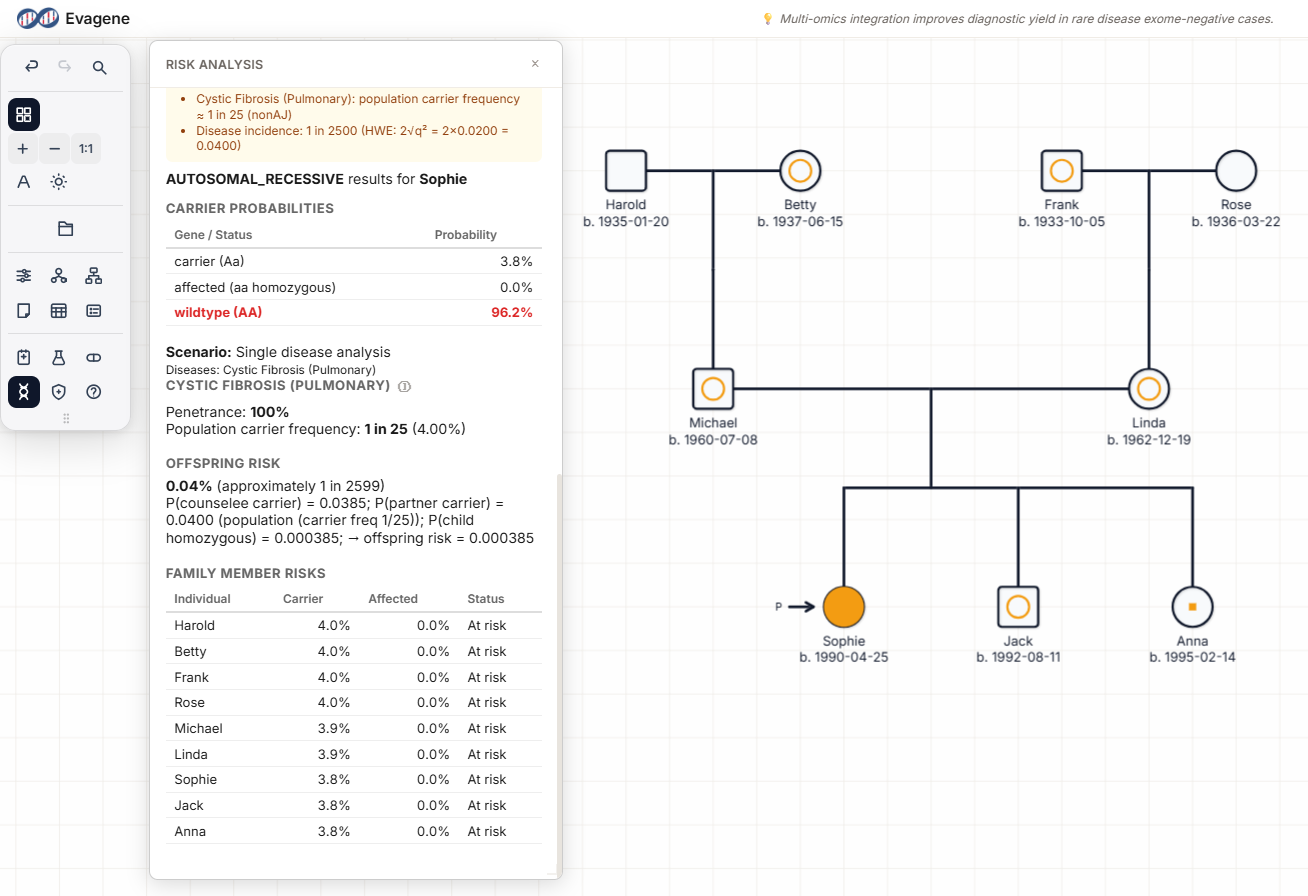
Ancestry-weighted carrier priors across the AR / XLR catalogue, non-classical inheritance modelling (XLD sex-differential severity, mitochondrial with heteroplasmy scaling, digenic, imprinting / UPD), reproductive-history fields for Gail and Tyrer-Cuzick, and CanRisk export for NICE moderate- and high-risk women.
Ancestry-gated carrier priors — explicit population key, weighted mix, or Hardy-Weinberg estimate attributed per row; no ancestry, no personalised number
Research-grade Mendelian modelling and linkage analysis
Go beyond clinical risk. Evagene supports autosomal dominant/recessive and X-linked models with reduced penetrance, germline mosaicism, de novo rates, anticipation (trinucleotide repeat expansion), parent-of-origin bias, and locus heterogeneity.
Configurable Haldane and Kosambi map functions for recombination fraction analysis
Species flexibility: custom ploidy and chromosome sets for non-human pedigrees
55+ allergies and 50+ traits with inheritance patterns, heritability estimates, and marker associations for genotype-phenotype correlation
Your family's health story, beautifully documented
No genetics knowledge required. Draw shapes on a canvas to build your family tree. Import your 23andMe results. Export a PDF to share with relatives or keep for personal reference. Evagene is educational only — not medical advice and not a substitute for consultation with a qualified clinician.
Colour-coded disease sectors and clear symbols make the pedigree readable at a glance
Import 23andMe data: raw genotype, ancestry, traits, and health history — with automatic blood type, Rh factor, and secretor status inference from SNP markers
Photograph a paper pedigree and import via image analysis (OCR + shape detection)
Plain-language educational summaries and beginner-friendly help guides — for learners, not medical advice
GEDCOM-compatible, information-dense family trees
Import from and export to GEDCOM 5.5.1 for interoperability with Ancestry, FamilySearch, Gramps, and other genealogy software. Migrate legacy XEG files and 23andMe data exports seamlessly.
Rich family data per individual: names, dates, contact information, ancestries, and rich-text notes with markdown formatting
Auto-layout, generation numbering, and the family register make large multi-generation pedigrees manageable
Dizygotic and monozygotic twin notation with proper chevron symbols
Automatic consanguinity detection via Wright's path coefficient identifies complex relationships
Learn genetics by doing, with correct conventions enforced
1,900+ help guides across six catalogues — diseases, traits, allergies, clinical tests, markers / genes, and treatments — each cross-linked and searchable. Students learn correct pedigree conventions by using a tool that enforces them from the first symbol.
230+ disease guides plus clinical-test, marker, and treatment catalogues (1,900+ entries total) — genetics, symptoms, diagnostic tests, prognosis, and Evagene walkthrough, all cross-linked
Risk model documentation explains the Bayesian mathematics behind BRCAPRO, MMRpro, PancPRO, and Mendelian models
Inspector provides a read-only blade-style UI for exploring how pedigree entities relate to each other
Standard notation enforced automatically — students learn correct conventions simply by using the tool
Reproduces peer-reviewed pedigree risk-model algorithms for educational exploration. Demonstrates how each published model behaves under different pedigree inputs. Algorithm implementations for teaching, training, and research — not clinical recommendations.
Reproduces three BayesMendel Bayesian algorithms (BRCAPRO, MMRpro, PancPRO) and nine family-history scoring algorithms on input pedigrees. Demonstrates how each published model behaves under different family-history configurations. Educational exploration only — not clinical outputs.
BRCAPRO
BayesMendel BRCA1/BRCA2 algorithm
Reproduces the BayesMendel BRCAPRO algorithm (Parmigiani et al.). Demonstrates how the published Bayesian family-history model behaves under different pedigree inputs.
Allele-frequency options: General, Ashkenazi Jewish, Italian
Algorithm reproduction for teaching and research
MMRpro
BayesMendel MLH1/MSH2/MSH6 algorithm
Reproduces the BayesMendel MMRpro algorithm. Explores how the published Lynch-syndrome model behaves across different pedigree configurations.
Algorithm reproduction for teaching and research
PancPRO
BayesMendel PALB2 / susceptibility algorithm
Reproduces the BayesMendel PancPRO algorithm. Explores how the published pancreatic-susceptibility model behaves on familial-pancreatic-cancer pedigree inputs.
Algorithm reproduction for teaching and research
Nine family-history scoring algorithms, reproduced
Each card below reproduces a specific peer-reviewed algorithm on pedigree input for educational exploration. Evagene does not state what the output means clinically — that is a matter for the published literature and qualified professionals.
CLAUS
Claus, Risch & Thompson 1994
Reproduces the CASH-derived algorithm for educational exploration of how a family-history-only Bayesian model behaves under varied pedigree inputs.
COUCH
Couch et al. 1997
Reproduces the published logistic-regression algorithm. Demonstrates how the model behaves under different age, ovarian, and Ashkenazi inputs.
FRANK / MYRIAD
Frank et al. 2002
Reproduces the empirical scenario-based frequency tables published from the Myriad dataset.
MANCHESTER
Evans et al. 2004
Reproduces the published Manchester point-based scoring algorithm. Algorithm demonstration; interpretation of output remains with the published literature.
NICE CG164 / NG101
NICE guideline categorisation
Reproduces the categorisation logic published in NICE CG164 and NG101 for educational reference. The guideline itself, not this software, is the source of any action.
AMSTERDAM II
Vasen et al. 1999
Reproduces the five-point Amsterdam II evaluation logic. Flags the pedigree-derivable criteria for teaching purposes.
BETHESDA (REVISED)
Umar et al. 2004
Reproduces the revised Bethesda criteria evaluation logic on input pedigrees. Algorithm reproduction for teaching reference.
GAIL (NCI BCRAT)
Gail 1989 (updates through 2017)
Reproduces the NCI BCRAT computation for educational exploration of how reproductive and family-history inputs drive the published algorithm.
TYRER-CUZICK
Tyrer / Duffy / Cuzick 2004 — approximation
Reproduces the published Tyrer-Cuzick 2004 algorithm. Approximation, not the official IBIS binary (full IBIS coefficients are not publicly released).
Single-gene & adjacent algorithms
Seven published inheritance-model algorithms, reproduced
Implementations of seven peer-reviewed pedigree inheritance models for educational exploration. Demonstrates how each behaves on pedigree input — autosomal dominant, autosomal recessive, X-linked recessive, X-linked dominant with sex-differential severity, mitochondrial maternal transmission, digenic two-locus interaction, and imprinting / UPD with parent-of-origin weighting.
mtDNA mutations transmitted through the maternal line. Sex-differential penetrance (e.g. LHON male preponderance). Phenotype severity scales with mutant-load (heteroplasmy).
Phenotype requires a simultaneous variant at two separate loci. An affected (Aa;Bb) × unaffected (aa;bb) partnership yields 25% affected offspring — the canonical digenic ratio. Supports both_het, one_het_one_hom, both_hom configurations.
Canonical disorders: Usher syndrome type 2, some RP, primary congenital glaucoma.
Four molecular mechanisms modelled (deletion, UPD, imprinting-centre defect, point mutation). Recurrence risk is weighted by mechanism; for IC defects, the parent-of-origin rule applies (transmitting parent determines which syndrome phenotype).
Ancestry-gated algorithm — no number without ancestry context
Hardy-Weinberg prior-carrier algorithms are notoriously easy to misuse by outputting a "general population" number for someone whose ancestry is not recorded. Evagene's implementation refuses that. If an individual has no ancestry recorded, the algorithm returns no personalised number for that individual. When ancestry is recorded, outputs are attributed to one of three explicit algorithm paths:
EXPLICIT POPULATION KEY
Direct published carrier frequency for that ancestry. Cystic fibrosis in Northern European, ~1 in 25. Tay-Sachs in Ashkenazi Jewish, ~1 in 30.
WEIGHTED MIX
Proportion-weighted combination across relevant populations when ancestry is mixed. Per-population contributions stay visible in the row.
HARDY-WEINBERG FROM INCIDENCE
Derived as 2pq where no population-specific carrier frequency is published. Flagged as an estimate, not a published figure.
Algorithm refuses to output a generic number
With no ancestry recorded, the algorithm returns no value for that individual. By design the software never outputs a single "general population" figure as though it applied to an identifiable person. The output is a property of the algorithm — not an opinion from the software about any individual.
Polygenic · Oligogenic · Multifactorial algorithm
Liability-threshold algorithm reproduction
Reproduces the published liability-threshold algorithm (Carter 1961, Falconer 1965, Reich / James / Morton 1972) on pedigree input, with the empirical family-study tables (Smith, Carter, Harper) where published. Demonstrates how the algorithm behaves across common complex disorders that cluster in families but do not follow Mendelian patterns. Algorithm reproduction for teaching and research — not clinical output.
Engine classifies affected relatives by degree
• MZ twin · 1st · 2nd · 3rd · 4th degree
• Empirical recurrence-risk tables when available
• Falconer liability-threshold fallback from h² and K
• Population baseline when no affected relatives
Four classical modifiers applied
• Severity of proband (mild / moderate / severe)
• Carter-effect sex bias (e.g. pyloric stenosis, DDH)
• Multiple affected close relatives
• Parental consanguinity: (1 + 2F·h²)
20+ conditions catalogued with heritability + empirical recurrence risks
Evagene does not compute BOADICEA. It writes a ##CanRisk 2.0 pedigree file (BOADICEA v4 column set) that the user downloads and uploads at canrisk.org, where the computation happens off-platform under University of Cambridge licence.
BOADICEA is licensed by the University of Cambridge; third-party web-service integration requires a separate commercial licence. Evagene therefore does not bundle BOADICEA — the file-export approach puts all computation and responsibility off-platform, where it belongs.
Build integrations, connect AI agents, push data to external systems, and embed pedigree diagrams in your own applications. Evagene's platform layer turns pedigree intelligence into infrastructure.
API Keys
Long-lived, scoped, rate-limited keys for programmatic access to the full Evagene API. SHA-256 hashed at rest. Configurable per-minute and per-day limits.
Bring Your Own LLM
Supply your own Anthropic or OpenAI API key for AI analysis. Encrypted at rest with Fernet. No quota limits. Choose your provider and model.
Webhooks
Push HMAC-SHA256 signed notifications when pedigrees change. Connect to EHR systems, LIMS, Slack, or any endpoint that accepts HTTP POST.
Analysis Templates
Reusable custom AI prompt templates with variable injection. Design analyses for pharmacogenomics, reproductive risk, research data extraction, or patient-friendly summaries.
MCP Server
Let AI agents work with pedigrees via the Model Context Protocol. 27 tools for Claude Desktop, custom agents, or any MCP-compatible client. Direct database access, no HTTP overhead.
Embeddable Viewer
Drop-in pedigree diagrams for patient portals, research dashboards, or any website. Three embedding modes: iframe, raw SVG, or a JavaScript snippet.
Evagene has been cited in clinical and genetic studies published in the Journal of Clinical Laboratory Analysis, Bioengineering, and Health Science Reports, covering Marfan syndrome, nephronophthisis, retinitis pigmentosa, and molecular diagnostics.
Every disease, trait, allergy, clinical test, genetic marker / gene, and treatment in Evagene has a dedicated help page with catalogue metadata, cross-references to related entries, and authoritative external links — LOINC for tests, NCBI Gene / OMIM / ClinVar for markers, RxNorm / BNF / DrugBank for treatments.
Covers the central dogma (DNA → RNA → protein), chromosome structure, Mendelian inheritance patterns, and how mutations lead to disease. Written for readers with no prior genetics background. Includes diagrams of DNA replication, meiosis, and autosomal vs. X-linked inheritance.
BRCAPRO uses Bayesian updating with the BayesMendel R package to estimate BRCA1/BRCA2 carrier probability from family pedigree data. Supports General, Ashkenazi Jewish, and Italian population frequencies. Published literature discusses ≥10% and ≥25% as notable thresholds; ≥25% is strongly suggestive of hereditary breast and ovarian cancer syndrome. These are educational references — not clinical recommendations from this software.
ICD-10: C50. OMIM: 114480. Inheritance: multifactorial with high-penetrance genes (BRCA1, BRCA2, TP53, PALB2). Lifetime risk ~12% general population; up to 72% for BRCA1 carriers. Evagene tracks laterality, ER/PR/HER2 status, grade, stage, and age at diagnosis per individual.
M/F/U to add individuals, P for partner, D for disease palette, N for notes, G for genetics panel. Ctrl+Z/Y for undo/redo, Ctrl+C/V for copy/paste, Ctrl+A to select all, F2 to edit name, Delete to remove. Space+drag to pan, scroll to zoom, Ctrl+G for snap-to-grid.
About Evagene
What Evagene is. A browser-based platform for drawing, managing, and exploring family pedigrees. Used by clinicians, counsellors, researchers, educators, students, and families for teaching, training, research, and structured family-history documentation.
What Evagene is not. Evagene is not a medical device. It is not intended to diagnose, prevent, monitor, predict, treat, or manage disease; determine eligibility for screening, testing, referral, or treatment; or replace professional clinical judgement. Outputs are illustrative and for educational and research purposes only.
Two risk-model caveats that apply everywhere on this site: Tyrer-Cuzick output is an IBIS-style approximation of the published Tyrer / Duffy / Cuzick 2004 algorithm, not the official IBIS Breast Cancer Risk Evaluator binary. BOADICEA is not bundled — licensed by the University of Cambridge; Evagene exports a ##CanRisk 2.0 pedigree file that the user uploads at canrisk.org.
Alpha Access
Join the Alpha waiting list
Be among the first to use Evagene. Alpha members receive early access, direct input on the roadmap, and priority support from the development team.
You're on the list!
We'll notify you as soon as alpha access opens. In the meantime, share Evagene with colleagues who work with pedigrees.
Share:
Alpha spots are limited
Join clinicians, researchers, and families already on the waiting list. Early members shape the roadmap and receive priority support.
We use cookies and similar technologies to analyse site traffic and improve your experience. Analytics cookies (Google Analytics, Microsoft Clarity) and marketing tools (EngageBay) are only activated with your consent. See our Privacy Policy for details.