Single-gene & liability models
Built-in Mendelian and liability-threshold models that compute automatically from a disease's recorded inheritance pattern.
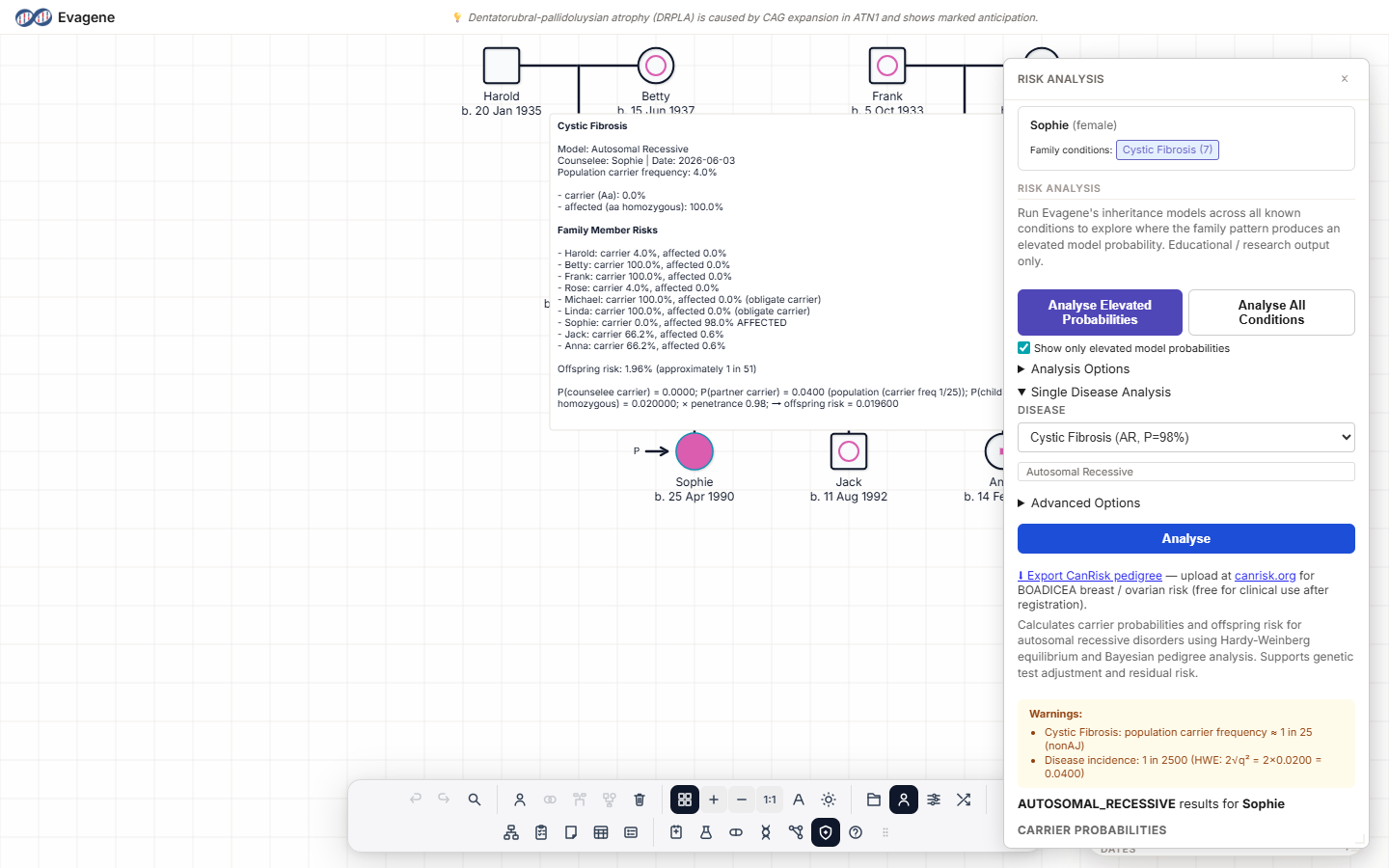
These models are the simplest to run because they map themselves. In the Single Disease Analysis section you pick the disease from the Disease dropdown — it shows e.g. “Cystic fibrosis (AR, P=100%)” — and the model badge sets itself from the disease's recorded inheritance pattern. The numbers produced are illustrative and for educational / research purposes; they are not clinical recommendations.
Where to find it & what it needs
Open the Risk Analysis panel from the dock, with a current pedigree and exactly one proband, then expand Single Disease Analysis. For the model to compute, the disease must be recorded on the affected individuals and configured with the relevant parameters:
- Recessive models — a carrier frequency or incidence figure.
- X-linked models — biological sex recorded on everyone.
- Dominant models — a penetrance value.
Selecting a disease automatically chooses one of the following models from its inheritance pattern:
| Inheritance pattern → model | Inheritance pattern → model |
|---|---|
| Autosomal dominant | Polygenic |
| Autosomal recessive | Oligogenic |
| X-linked recessive | Digenic |
| X-linked dominant | Imprinting |
| Mitochondrial | Robertsonian translocation |
| Multifactorial | Reciprocal translocation |
Advanced Options & running
Advanced Options exposes model-specific parameters — for example a Population selector for recessive models, or a “Maternal heteroplasmy (0–1)” field for mitochondrial models. When ready, click Analyse.
Reading the output (illustrative)
- A Family Member Risks table listing carrier probability, affected probability, and status per individual.
- An offspring-risk figure with a plain explanation.
- For recessive models, a population carrier frequency shown as “1 in N”.
- For liability-threshold models (multifactorial / polygenic / oligogenic, based on Falconer 1965), a recurrence risk shown as “1 in X” with a green / amber / red band.
In the Family Member Risks table, rows at or above 10% are highlighted amber, and rows at or above 25% red. These bands are illustrative reading aids for teaching, not clinical thresholds.
Worked example · Autosomal-recessive carrier and offspring risk
A fictional family with an autosomal-recessive condition (here, cystic fibrosis). Every number below is illustrative and for educational / research purposes only.
- 1Build a small family and mark the affected child with an AR disease (cystic fibrosis), recorded on the affected individual.
- 2Set one individual as the proband so the panel enables, then open Risk analysis from the dock.
- 3Expand “Single Disease Analysis” and choose the AR disease in the Disease dropdown. The badge becomes Autosomal Recessive.
- 4Optionally set a Population under Advanced Options, then click Analyse.
- 5Read the illustrative output — the population carrier frequency (“1 in N”), the Family Member Risks table, and the offspring risk. The figures are educational illustrations of the published model, not a prediction about any real person.
Good to know. If the badge looks wrong, it is reading the disease's recorded inheritance pattern — fix the pattern on the disease, not in the panel. Liability-threshold results depend on the incidence and heritability you record; with those blank, a multifactorial disease cannot produce a Falconer 1965 recurrence figure.
About Evagene. Evagene is an academic, research, and educational pedigree modelling platform. It supports structured family-history documentation, teaching, and exploratory use of published risk models. Evagene is not intended to diagnose, prevent, monitor, predict, treat, or manage disease; determine eligibility for screening, testing, referral, or treatment; or replace professional clinical judgement. Outputs are illustrative and for educational / research purposes only.