Cancer family-history scores & Tyrer-Cuzick
Published breast/ovarian and Lynch family-history scoring criteria, plus the IBIS-style Tyrer-Cuzick approximation — run across the whole pedigree.
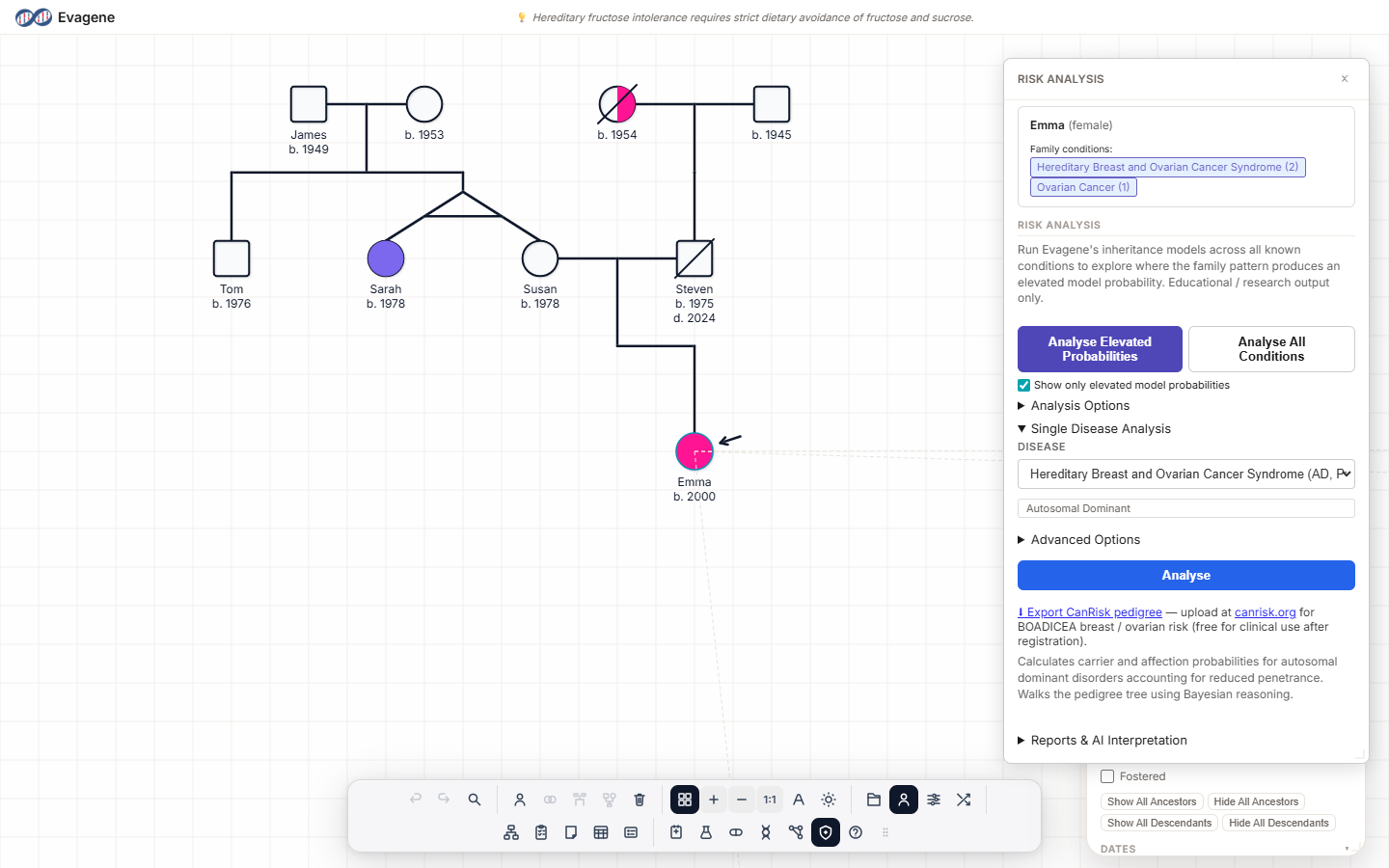
Unlike the single-gene models, these criteria do not auto-map from a disease. You reach them by opening Advanced Options and choosing from the Model override dropdown. Once selected, they scan the whole pedigree — there is no disease selection. All output is illustrative and for educational / research purposes only.
Where to find it & what it needs
Open the Risk Analysis panel from the dock, set exactly one proband, expand Single Disease Analysis, then open Advanced Options → Model override. The reproductive and breast-health fields that drive Gail 1989 and Tyrer-Cuzick live on each person's Individual record.
The scoring criteria (all illustrative)
| Model | Illustrative output |
|---|---|
| Claus 1994 | Breast ± ovarian affected relatives with ages → an illustrative lifetime breast-cancer figure. |
| Couch 1997 | Breast/ovarian family plus Ashkenazi Jewish ancestry → an illustrative BRCA1 carrier probability. |
| Frank 2002 | Illustrative BRCA1 / BRCA2 / any-BRCA probabilities. |
| Evans 2004 (Manchester scoring system) | BRCA1 and BRCA2 scores, with the published ≥16 ≈ 10% and ≥20 ≈ 20% thresholds shown as published reference points. |
| NICE family-history category | Shows the external NICE category. Where the criterion would refer, an inline note states this is the external NICE criterion and Evagene does not make that recommendation. |
| Vasen 1999 (Amsterdam II criteria, Lynch syndrome) | Criteria met / not met, with a note that this is the external criterion and Evagene makes no clinical recommendation. |
| Umar 2004 (revised Bethesda guidelines) | Trigger met / not met, with the same disclaimer that this is the external criterion and Evagene makes no recommendation. |
| Gail 1989 | Needs reproductive fields on the proband — age at menarche, age at first live birth or parity, number of breast biopsies, atypical hyperplasia — and produces illustrative 5-year and lifetime figures. |
Tyrer / Duffy / Cuzick 2004 — the IBIS-style approximation
Evagene's Tyrer-Cuzick model is an IBIS-style approximation of the published Tyrer / Duffy / Cuzick 2004 algorithm — not the official IBIS Breast Cancer Risk Evaluator binary (whose full coefficients are not public). When run it shows a mandatory “⚠ Approximation” banner that routes you to the official IBIS tool or to CanRisk for definitive numbers.
Inputs include family history plus reproductive factors, HRT years, BMI, atypical hyperplasia / LCIS, benign biopsies, mammographic density (BI-RADS), and Ashkenazi ancestry. The output is an illustrative relative risk, 10-year and lifetime figures, and a per-factor component table.
Worked example · Run the Tyrer-Cuzick approximation
A fictional family. Every figure produced is an illustrative approximation for teaching and research, not a clinical estimate for any real person.
- 1Set one proband and open Risk analysis from the dock.
- 2Expand Single Disease Analysis → Advanced Options → Model override and choose Tyrer-Cuzick (IBIS-style approximation).
- 3Click Analyse.
- 4Read the illustrative figures, noting the “⚠ Approximation” banner and that definitive numbers come from the official IBIS tool or from CanRisk (see the CanRisk page).
Good to know. The NICE, Amsterdam II (Vasen 1999), and Bethesda (Umar 2004) outputs report whether an external published criterion is met. Where such a criterion has a “refer” output, Evagene illustrates how that external criterion may be represented and does not itself make that recommendation. Always confirm Tyrer-Cuzick figures against the official IBIS Breast Cancer Risk Evaluator binary — Evagene's is an approximation only.
About Evagene. Evagene is an academic, research, and educational pedigree modelling platform. It supports structured family-history documentation, teaching, and exploratory use of published risk models. Evagene is not intended to diagnose, prevent, monitor, predict, treat, or manage disease; determine eligibility for screening, testing, referral, or treatment; or replace professional clinical judgement. Outputs are illustrative and for educational / research purposes only.