BayesMendel models — BRCAPRO, MMRpro, PancPRO
Bayesian carrier-probability and future-risk models from the BayesMendel family, for educational and research exploration.
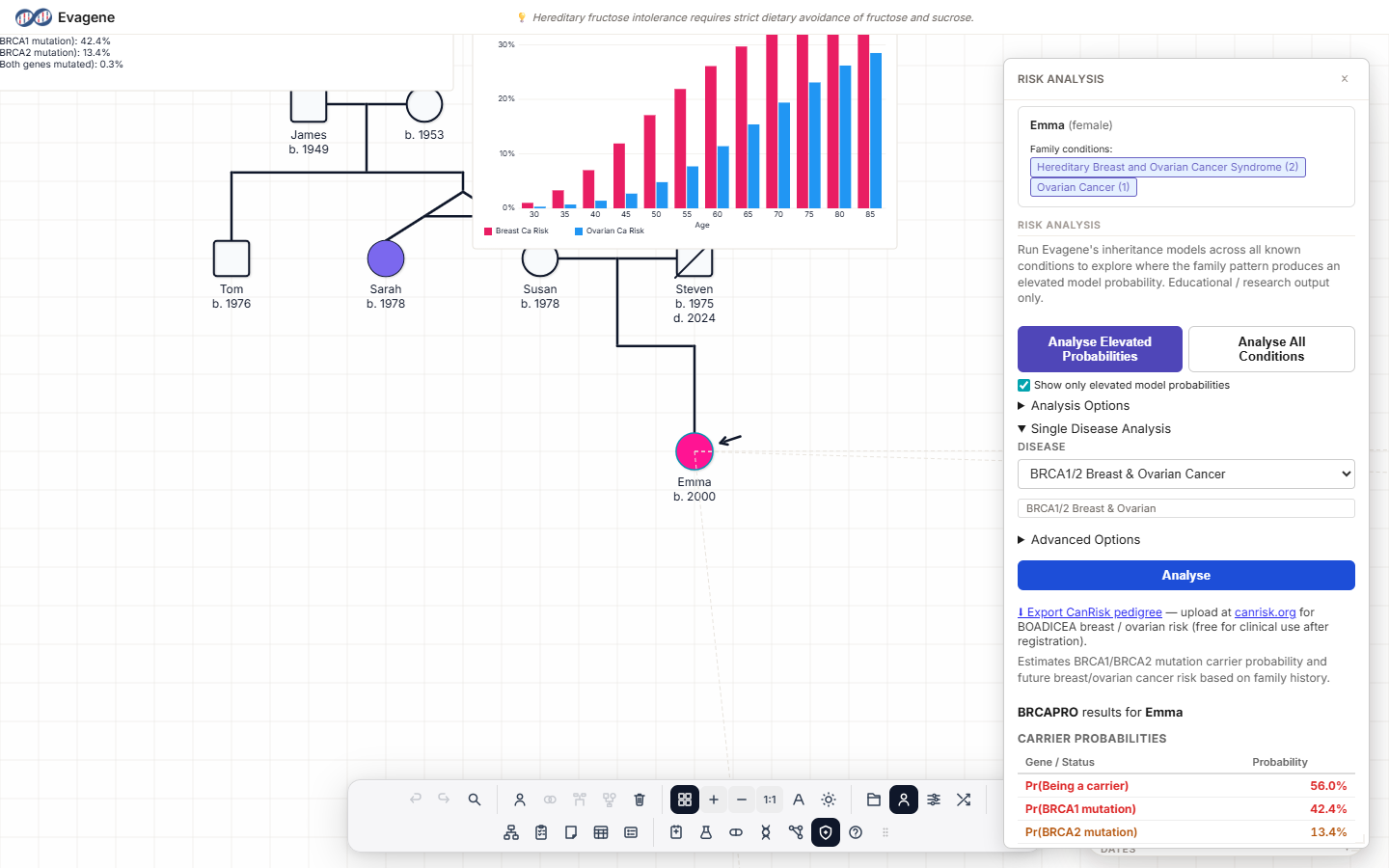
The BayesMendel family — BRCAPRO, MMRpro, and PancPRO — brings Bayesian carrier-probability and future-risk modelling to the pedigree. The statistical heritage is part of the claim, so we use the name BayesMendel throughout. Every figure produced is illustrative and for educational / research purposes only.
Where to find it & what it needs
Open the Risk Analysis panel from the dock, set exactly one proband, and expand Single Disease Analysis. You reach these models from the Disease dropdown's Specialist Models group:
- BRCA1/2 Breast & Ovarian Cancer (BRCAPRO)
- Lynch Syndrome (Mismatch Repair) (MMRpro)
- Pancreatic Cancer (PancPRO)
These models require a statistical sidecar to be running. If it is not, the panel shows “R sidecar not running”. Prerequisites:
- The relevant cancers marked on affected individuals, with ages at diagnosis.
- A Population selector under Advanced Options — General non-AJ / Ashkenazi Jewish / Italian.
When ready, click Analyse.
Reading the output (illustrative)
- A per-gene carrier-probability table — BRCA1 / BRCA2, or MLH1 / MSH2 / MSH6, or a single susceptibility depending on the model.
- A future cumulative cancer-risk-by-age table.
Worked example · BRCAPRO carrier probabilities
A fictional breast/ovarian family. The probabilities below are illustrative educational output, not a prediction about any real person.
- 1Mark the affected relatives with their cancers and ages at diagnosis.
- 2Set one proband, then open Risk analysis → Single Disease Analysis.
- 3In the Disease dropdown choose BRCA1/2 Breast & Ovarian Cancer from Specialist Models.
- 4Set a Population under Advanced Options, then click Analyse.
- 5Read the illustrative output — the BRCA1 / BRCA2 carrier probabilities and the risk-by-age table. The numbers are illustrative and for educational / research purposes only.
Good to know. If you see “R sidecar not running”, the BayesMendel computation cannot proceed — the statistical sidecar must be running first. Ages at diagnosis matter: the Bayesian update is driven by who was affected and when, so missing ages weaken the illustrative estimate.
About Evagene. Evagene is an academic, research, and educational pedigree modelling platform. It supports structured family-history documentation, teaching, and exploratory use of published risk models. Evagene is not intended to diagnose, prevent, monitor, predict, treat, or manage disease; determine eligibility for screening, testing, referral, or treatment; or replace professional clinical judgement. Outputs are illustrative and for educational / research purposes only.